Friday, September 30, 2011

Georges Simenon


With Simenon, early one morning, lying awake in the Hotel Berthe, the need was so great that when he heard a chambermaid outside in the hallway cleaning the guests' shoes, he got up, opened the door, lifted the girl's skirt and possessed her on the spot -- while she was brushing away.  She did not even stop what she was doing but merely said: "Oh Monsieur!"
Surely you didn't think Dominique Strauss-Kahn was the first Frenchman to jump a hotel maid's bones.

I've decided that the last Friday of each month will no longer be just another "Rap Friday" but rather a "French Fri-day."  (Très drôle, monsieur 2 or 3 lines!)  

Simenon, who is best known for his 75 "Inspector Maigret" detective novels,  wrote 400-plus books altogether, which were translated into 55 languages and sold 550 million copies.  He claimed to have bedded 10,000 women (including 8000 prostitutes, whom he claimed to have treated like a gentleman: "I always let them have their pleasure first").

His second wife said that the figure of 10,000 was grossly exaggerated.  She thought the correct number was closer to 1200.  (Isn't it just like a man to exaggerate?  And isn't it just like a wife to spoil his fun?)

By the way, Simenon was born in Belgium -- but in the French-speaking part of Belgium.  Close enough.


Simenon avec sa pipe

Thursday, September 29, 2011

Lord Nelson


Firstly, you must always implicitly obey orders, without attempting to form any opinion of your own regarding their propriety. Secondly, you must consider every man your enemy who speaks ill of your king.  And thirdly, you must hate a Frenchman as you hate the devil.
Vice Admiral Horatio Lord Nelson, who was born on this date in 1758, gave this advice to a young midshipman in 1793, when Nelson was the captain of the 64-gun ship of the line, HMS Agamemnon.

Nelson was the preeminent naval commander of the Napoleonic Wars, known for his inspirational leadership and unconventional tactics.  He lost his right eye in 1793 during a successful assault on a Corsican fort, and his right arm during an unsuccessful attack on a port in the Canary Islands.  

Nelson's successes in battle greatly outnumbered his failures.  His greatest victory came at the Battle of Trafalgar in 1805, when his 27 British ships of the line (which were equipped with a total of 2148 guns) decisively defeated 33 French and Spanish ships of the line (which carried a total of 2632 guns).  Prior to that battle, he met with his officers to brief them on his plan of battle, instructing them that "in case signals can neither be seen or perfectly understood, no captain can do very wrong if he places his ship alongside that of the enemy."    

Nelson was shot and killed by a French sniper during the battle.  According to his biographer, Nelson had responded to a previous suggestion that he conceal the admiral's stars on his uniform during battle with these words: "In honour I gained them, and in honour I will die with them." 

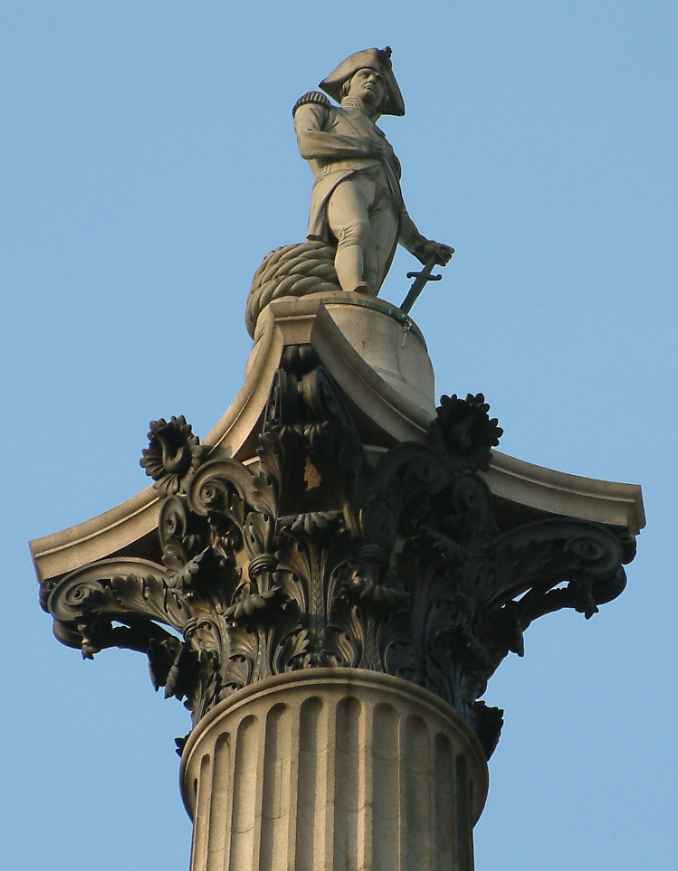
Nelson's Column, Trafalgar Square, London


Wednesday, September 28, 2011

Peter de Vries


Revision is mostly compression -- frying the fat out of it, I call it.  When I see a paragraph shrinking under my eyes like a strip of bacon in a skillet, I know I'm on the right track.
(Peter de Vries died on this date in 1993.  He was on the staff of the New Yorker for over 40 years and wrote short stories, poetry, essays, a play, and 23 novels -- all of which were out of print by the time of his death.  There's a copy of his first novel -- But Who Wakes the Bugler? -- at my in-laws' Cape Cod house.  I see it every summer, but have never been tempted to read it.  I do admire the title greatly, however.  This quote is from a 1968 article he wrote for Life magazine.)

Tuesday, September 27, 2011

Lhasa de Sela


My heart is breaking
I cannot sleep
I love a man
Who's afraid of me
He believes if he doesn't
Stand guard with a knife
I'll make him my slave
For the rest of his life
(From her 2003 song, "Anywhere On This Road."  Lhasa de Sela was born on this date in 1972.  She died of breast cancer on January 1, 2010.)


Monday, September 26, 2011

Victor Hugo


[S]trange to say, the first symptom of true love in a young man is timidity; in a young girl it is boldness.  This is surprising, and yet nothing is more simple.  It is the two sexes tending to approach each other and assuming each the other's qualities.
From his monumental 1862 novel, Les Misérables.  In France, Hugo is remembered first as a poet -- some consider him the greatest of all French poets.  Outside of France he is best known for his novels Les Misérables and The Hunchback of Notre-Dame.

Hugo is buried in the Panthéon, which was built as a church but converted during the French Revolution to a mausoleum for the interment of prominent Frenchmen.  Among those buried there are Voltaire, Rousseau, Zola, Marie Curie, and Louis Braille.  The Panthéon is located in the Latin Quarter, and is an impressive sight from a sidewalk table at a student restaurant where I once enjoyed a meal of moules, frites, and Belgian beer and read A Moveable Feast.
The Panthéon, Paris


Sunday, September 25, 2011

Erich Maria Remarque


He fell in October 1918, on a day that was so quiet and still on the whole front, that the army report confined itself to the single sentence: All quiet on the Western Front. He had fallen forward and lay on the earth as though sleeping. Turning him over one saw that he could not have suffered long; his face had an expression of calm, as though almost glad the end had come.
From his novel, All Quiet on the Western Front, which was published in 1929.

Remarque, who grew up in a working-class family, was drafted into the German army in 1916, when he was 18.  In 1917, he was wounded by shrapnel and spent the rest of the war in a military hospital.

Remarque married American movie star Paulette Goddard -- whose three ex-husbands included Charlie Chaplin -- in 1958.  He was 60, she was 48.  

Remarque died on this date in 1970.

Erich Maria Remarque


Saturday, September 24, 2011

H. G. Wells


[I]t seemed to him now that life had never begun for him, never!  It was if his soul had been cramped and his eyes bandaged from the hour of his birth.  Why had he lived such a life?  Why had he submitted to things, blundered into things?  Why had he never insisted on the things he thought beautiful and the things he desired, never sought them, fought for them, taken any risk for them, died rather than abandon them?  They were the things that mattered.  Safety did not matter.  A living did not matter unless there were things to live for . . .
From his 1910 novel, The History of Mr. Polly, which I highly recommend.  (Mr. Polly and I have a lot in common -- for example, our love of bicycles.)

Wells is remembered today mostly for his science-fiction novels (including The Time Machine, The Invisible Man, and The War of the Worlds) but he wrote a number of novels that focused on lower-middle-class life and social change, as well as a bestselling three-volume history of the world.

Wells was in Warren Beatty's league when it came to the ladies.  He married his cousin when he was 25, but left her a few years later to marry one of his students, Amy Catherine Robbins.  She and Wells stayed married until her death despite his numerous affairs (some of which she knew about) -- his paramours included the American birth-control activist Margaret Sanger.  He had children out of wedlock with writer Amber Reeves and novelist Rebecca West.