Showing posts with label Ozymandias. Show all posts

Friday, December 23, 2011

Horace Smith


In Egypt's sandy silence, all alone, 
Stands a gigantic Leg, which far off throws 
The only shadow that the Desert knows. 
"I am great Ozymandias," saith the stone, 
"The King of kings: this mighty city shows 
The wonders of my hand." The city's gone! 
Naught but the leg remaining to disclose 
The sight of that forgotten Babylon. 
We wonder, and some hunter may express 
Wonder like ours, when through the wilderness 
Where London stood, holding the wolf in chase, 
He meets some fragment huge, and stops to guess 
What wonderful, but unrecorded, race 
Once dwelt in that annihilated place. 

Horace Smith was a prosperous stockbroker who not oversaw Percy Bysshe Shelley's finances, but also was a close friend of who collaborated with Shelley on a popular book of literary parodies.  

Smith is best-known today because he participated in a sonnet-writing contest with Shelley, the subject of which was the celebrated Egyptian pharaoh, Ramesses II.  Shelley's poem was titled "Ozymandias."  Smith's sonnet was titled "On a Stupendous Leg of Granite, Discovered Sanding by Itself in the Deserts of Egypt."  (Catchy, huh?) 

Shelley's poem is far superior, but I like Smith's idea of having a hunter in the distant future stumble across the ruins of London.  Those ruins would be as puzzling to that hunter as the world of the Egyptian pharaohs is to us today. 

Ramesses II


Thursday, December 22, 2011

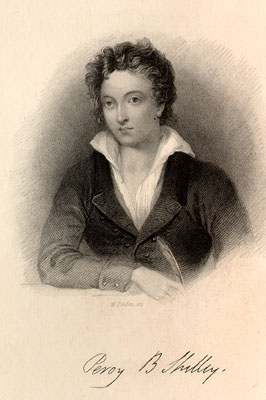
Percy Bysshe Shelley


I met a traveller from an antique land
Who said: "Two vast and trunkless legs of stone
Stand in the desert. Near them on the sand,
Half sunk, a shattered visage lies, whose frown
And wrinkled lip and sneer of cold command
Tell that its sculptor well those passions read
Which yet survive, stamped on these lifeless things,
The hand that mocked them and the heart that fed.
And on the pedestal these words appear:
'My name is Ozymandias, King of Kings:
Look on my works, ye mighty, and despair!'
Nothing beside remains. Round the decay
Of that colossal wreck, boundless and bare,
The lone and level sands stretch far away". 

I know, I know . . . that's a lot more than two or three lines.  But which lines would you have me cut?  There's no fat in this poem -- it's all muscle.

Shelley wrote this poem in 1817, when he was 25 years old.  He drowned while sailing off the west coast of Italy in 1822, a month before his 30th birthday.

"Ozymandias" (pronounced with four syllables to fit the meter of the poem) is a Greek name for Ramesses II (who is also known as "Ramesses the Great"), the most celebrated of all Egyptian pharaohs. 

Shelley's poem reminds us of a truth that is bitter to many, but impossible to refute.  No matter how monumental the accomplishments of a man may be, there will come a time when his works will decay into a "colossal wreck," leaving those who come later to observe (as did Shelley): "Nothing beside remains."

Or, to put it another way, Vanitas vanitatum, omnia vanitas.

Percy Bysshe Shelley