Friday, October 14, 2011

Paul Verlaine


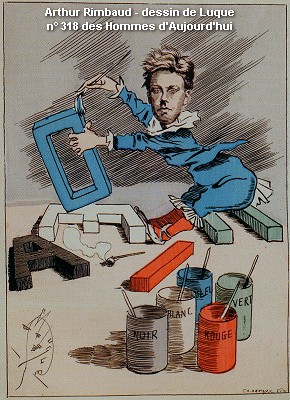
Moi qui ai connu Rimbaud, je sais qu'il se foutait pas mal si "A" était rouge ou vert. Il le voyait comme ça, mais c'est tout.
(I, who knew Rimbaud, know that he really didn't give a damn whether "A" was red or green. He saw it like that, but that's all.)

From a letter written by Paul Verlaine to fellow poet Pierre Louÿs, referring to Arthur Rimbaud's poem, "Voyelles," which was the subject of 2 or 3 lines yesterday.  (We're skipping "Rap Friday" this week.  Actually we're skipping it all month.) 
As previously noted, Rimbaud moved to Paris at the invitation of symbolist poet Paul Verlaine (who had a pregnant wife at the time) just before his 17th birthday.  The two poets had a short and torrid affair and consumed mass quantities of absinthe and hashish.  After moving to London together, the two quarreled constantly and Verlaine returned to Paris after a few months.  

Shortly thereafter, he had a change of heart, telegraphed Rimbaud, begging the younger poet to meet him in Brussels, which Rimbaud quickly agreed to do.  The reunion went badly and Verlaine shot Rimbaud in the left wrist.  Verlain was later sentenced to two years in prison, where he converted to Catholicism.  Verlaine later descended into drug addiction, alcoholism, and poverty, and he died in 1896, when he was 51.  

This is all very French, don't you think?

Paul Verlaine drinking absinthe in Paris


Thursday, October 13, 2011

Arthur Rimbaud


A noir, E blanc, I rouge, U vert, O bleu: voyelles,
Je dirai quelque jour vos naissances latentes:
[Black A, white E, red I, green U, bleu O: vowels
Someday I'll reveal the secret of your birth.]
From Arthur Rimbaud's Alexandrian sonnet, "Voyelles" ("Vowels"), which he wrote in 1870 or 1871 but which was not published until 1883.  (The translation is by Holly Tannen.)  I have no idea why the U comes before the O -- some crazy French thing, I'm sure.

The lines of a poem written using the Alexandrian meter consists of two half-lines of six syllables each.  (That is very different from saying that a Alexandrian poem consists of lines with twelve syllables each.)  The break between the half-lines -- that is, the break between the sixth and seventh syllables -- should be a major syntactic break. 

Rimbaud, who was a born in 1854, was a precocious student who published his first poem when he was only 15.  He moved to Paris at the invitation of symbolist poet Paul Verlaine just before his 17th birthday.  Rimbaud stopped writing poetry before he turned 21 and became a businessman.  He died of cancer when he was 37.

It's "French-day the 13th," and all this is about as French as it gets.  

So are you impressed that I was able to figure out how to make each vowel the right color?


Wednesday, October 12, 2011

Christopher Columbus


I should not proceed by land to the east, as is customary, but by a westerly route, in which direction we have hitherto no certain evidence that any one has gone.
From an August 3, 1492 diary entry.

On this date in 1492, Italian explorer Christopher Columbus (his name in Italian was Cristoforo Colombo) landed on an island in the Bahamas, which the natives called Guanahani and which he named San Salvador.  No one knows exactly which of the 29 islands or 667 cays that make up the Bahamas was the one that Columbus first landed on.

Columbus made four voyages to the New World between 1492 and 1502.  He explored Cuba, Hispaniola, Puerto Rico, Jamaica, Dominica, Antigua, Nevis, St. Kitts, Trinidad, Tobago, Grenada, Martinique, and many other Caribbean islands, as well as parts of Honduras, Nicaragua, Costa Rica, and Panama.


Tuesday, October 11, 2011

Monsters of Folk


Then I fell in love with identical twins
That lived 34 summers between the two of them
I gave one my ego, I gave one my id
From their 2009 song, "Man Named Truth."  I'll let you do the math.  (Obviously, the superego did not come into play.)

So why is this being posted on "Bad Romance Tuesday?"  Seventeen-year-old identical twins sounds like about as good a romance as a guy can imagine.

Unless you happen to be the father of those twins, of course.     


Monday, October 10, 2011

Gary P. Nunn


Even London Bridge 
Has fallen down
And moved to Arizona
From his song, "London Homesick Blues," which was the last track on Jerry Jeff Walker and the Lost Gonzo Band's 1973 album, Viva Terlingua!

Before he hooked up with Walker, Nunn had been a pharmacy major at the University of Texas at Austin.  That may have been as important a reason for his invitation to join the band as his musical skills.  

When I was a law student in Boston, listening to this song would virtually paralyze me with homesickness for Texas (although Texas wasn't really my home).  Boston's not London, of course, but they are just about equally foreign to Texans. 

London Bridge, which was built to span the River Thames in 1831, was dismantled in 1967 and moved to Lake Havasu City, Arizona.  It opened to traffic on this date in 1971.


Sunday, October 9, 2011

F. Scott Fitzgerald


"Who is he anyhow, an actor?" . . .
"No, he's a gambler." Gatsby hesitated, then added cooly: "He's the man who fixed the World Series back in 1919." 
"Fixed the World Series?" I repeated. 
  
The idea staggered me.  I remembered, of course, that the World Series had been fixed in 1919, but if I had thought of it at all I would have thought of it as something that merely happened, the end of an inevitable chain. It never occurred to me that one man could start to play with the faith of fifty million people -- with the singlemindedness of a burglar blowing a safe. 
From The Great Gatsby.  The character that Gatsby is speaking of was based on Arnold Rothstein, a New York gambler who was the kingpin of the so-called "Jewish mafia" and the brains behind the conspiracy to fix the 1919 World Series.

On this date in 1919, the Chicago White Sox -- known to baseball fans ever since as the "Black Sox" -- lost the eighth and deciding game of the Series to the Cincinnati Reds, 10-5.  (The World Series was a best-of-nine contest in 1919, 1920, and 1921, before reverting to the more familiar best-of-seven format in 1922.)

Rumors that the Series had been fixed dogged the White Sox throughout the 1920 season, and a grand jury was convened to investigate in September of that year.  Although the players who were accused of conspiring with gamblers to throw the Series were acquitted by a Chicago jury in August 1921, the newly appointed commissioner of baseball -- the former federal judge Kenesaw Mountain Landis -- banned the eight Black Sox from organized baseball for life.

Chick Gandil, Black Sox ringleader


Saturday, October 8, 2011

Walter Lord


It would be nice to say the rich people, the fancy people, all behaved like bastards and the poor slobs all came through like heroes. But as a matter of fact, sometimes the poor slobs behave like slobs and the great, noble, privileged characters come off very well, indeed. 
From a 1981 interview with Lord about A Night to Remember (1955), his best-selling book about the sinking of the Titanic, which I recall as being one of the most compelling books in the Joplin Public Library.

Walter Lord was born on this date in 1917.  He was a graduate of Princeton and Yale Law School, and also wrote best-selling popular histories on Pearl Harbor, the Battle of Midway, the Battle of the Alamo, the War of 1812, and the Peary expedition to the North Pole.  

Walter Lord in 1958