Sunday, January 1, 2012

Semisonic


Closing time 
One last call for alcohol 
So finish your whiskey or beer 
Closing time 
You don't have to go home 
But you can't stay here . . .
Closing time
Every new beginning 
Comes from some other beginning's end

That's all there is, folks -- there ain't no more. 

Don't go away mad . . . just GO AWAY!


Saturday, December 31, 2011

Patricia Barber


Will he 
kiss her on New Year's Eve, 
after the last guests leave, 
then kiss her again? 
From "The New Year Eve's Song" (2008).  

Guy Lombardo and his Royal Canadians used to own New Year's Eve with their version of "Auld Lang Syne."  But for my money, Patricia Barber owns New Year's Eve now.

When the members of a band goes on "indefinite hiatus," that's usually all she wrote, although sometimes they will get back together and pick up where they left off.  After tomorrow, 2 or 3 lines a day will be on indefinite hiatus -- at least for a year, perhaps forever.  Que sera, sera . . .

Click here to read more about "The New Year's Eve Song."


Friday, December 30, 2011

John Donne


No man is an island, entire of itself; every man is a piece of the continent, a part of the main. If a clod be washed away by the sea, Europe is the less . . . any man's death diminishes me, because I am involved in mankind, and therefore never send to know for whom the bell tolls; it tolls for thee.

From "Meditation XVII" of his Devotions Upon Emergent Occasions (1623).

Tomorrow the bell tolls for 2 or 3 lines a day.

2 or 3 lines a day simply required too much time and effort given the relatively small audience it attracted, so I've decided to pull the plug after doing 365 posts.  Those select few of you who read 2 or 3 lines a day regularly were kind enough to send me many kind comments during the year, and I appreciate your loyalty very much.

Thursday, December 29, 2011

Joey Eischen

He's going to have to suck on it and like it.
Joey Eischen was a major-league pitcher for all or part of 10 seasons, mostly with the Montreal Expos and Washington Nationals.

Eischen's comment was directed at Peter Angelos, the owner of the Baltimore Orioles, who had opposed the move of the franchise from Montreal to Washington in 2005 because he feared having a second major-league team so close to Baltimore would reduce attendance at Orioles games.

Joey's pithy comment says a lot about our daily existence in just one sentence.  So does this sentence: "The sh*t always rolls downhill."  If my children take these two sayings to heart, they will be well-prepared for the working world.

Joey Eischen
Orioles owner Peter Angelos

Wednesday, December 28, 2011

Charles Portis


I felt a visceral twinge of pain, lungs maybe, and I sat down on the bed to wait for it to pass.  The pain was concentrated in one burning spot about the size of a dime.  I wondered if I might have been hit by a small stray bullet sometime during the afternoon.  I had handled news accounts of men who had been shot and then walked about for hours, days, a lifetime, unaware of such wounds.
From his 1979 novel, Dog of the South.  The reclusive Portis, who was born on this date in 1933, is as deadpan as a novelist as there is.  He is best known for his 1968 novel, True Grit, which has been adapted for the movies twice.

Portis learned to write as a reporter for the University of Arkansas student newspaper and the Northwest Arkansas Times.  He worked in both New York City and London for the legendary New York Herald-Tribune before leaving journalism in 1964 to write novels.

Portis grew up in El Dorado, Arkansas, which is also the home of Baseball Hall of Famer Lou Brock, Country Music Hall of Famer Lefty Frizzell, and Pro Football Hall of Famer Lamar Hunt (who was one of the founders of the old American Football League and owner of the Kansas City Chiefs).

I spent part of August 9, 1974 -- the day that Richard Nixon resigned as President of the United States -- in El Dorado, trying to get my overheating 1970 Olds Cutlass fixed.  After having the coolant/antifreeze drained and replaced, the radiator cap replaced, and the thermostat replaced, it was determined that the problem was just a faulty temperature sensor -- my engine wasn't really overheating at all.  


Tuesday, December 27, 2011

John Sebastian


My darling be home soon
I couldn't bear to wait 
An extra minute if you dawdled

You're probably wondering why these lyrics -- from the Lovin' Spoonful's 1967 hit, "Darling Be Home Soon" -- are being featured on "Bad Romance Tuesday."

After all, that song is about a couple that is very much in love?  The singer is so head-over-heels that he can't bear to be apart from his lover for even one extra minute.  Awwwwww . . . how sweet is that?

HA!

How clueless can one guy be?  I guess he never asked himself JUST WHERE HAS SHE BEEN DAWDLING ALL THIS TIME?  AND WITH WHOM?

Wake up and smell the cat food, dumbass!  Someone is crushing it while you are sitting around singing a dopey song!  ("And I feel myself in bloom"?  Gag me with a spoon.)


Monday, December 26, 2011

W. H. Auden


Well, so that is that. Now we must dismantle the tree,
Putting the decorations back into their cardboard boxes --
Some have got broken -- 

And carrying them up to the attic. . . .
The Christmas Feast is already a fading memory,
And already the mind begins to be vaguely aware
Of an unpleasant whiff of apprehension at the thought
Of Lent and Good Friday which cannot, after all, now
Be very far off. . . . 

In the meantime there are bills to be paid, 
Machines to keep in repair,
Irregular verbs to learn, 

The Time Being to redeem from insignificance. 
The happy morning is over,
The night of agony still to come . . .
From his long poem, "For The Time Being: A Christmas Oratorio," which was published in 1944.

W. H. Auden

Sunday, December 25, 2011

Charles Dickens


"Men's courses will foreshadow certain ends, to which, if persevered in, they must lead," said Scrooge. "But if the courses be departed from, the ends will change."

In Charles Dickens's A Christmas Carol (1843), Ebenezer Scrooge changed his ways after he was visited by the Ghost of Christmas Past, the Ghost of Christmas Present, and the Ghost of Christmas Yet To Come.

If Scrooge was able to learn from his mistakes and start to do the right thing, so can you.  (And so can I.)

Merry Christmas from 2 or 3 lines a day to you and yours!


Saturday, December 24, 2011

Hamilton Camp


Turn around, go back down 
Back the way you came
Babylon is laid to waste 
Egypt's buried in her shame
Their mighty men are beaten down 
The kings are fallen in the ways
Oh God, the pride of man 
Broken in the dust again 

From his 1964 song, "Pride of Man."  Camp, an English folksinger, actor, and voiceover artist, made his folksinging debut at the Newport Folk Festival in 1960.  "Pride of Man" was covered by Quicksilver Messenger Service and Gordon Lightfoot.

Don't tell me that Camp didn't have "Ozymandias" in mind when he wrote "Pride of Man."


Friday, December 23, 2011

Horace Smith


In Egypt's sandy silence, all alone, 
Stands a gigantic Leg, which far off throws 
The only shadow that the Desert knows. 
"I am great Ozymandias," saith the stone, 
"The King of kings: this mighty city shows 
The wonders of my hand." The city's gone! 
Naught but the leg remaining to disclose 
The sight of that forgotten Babylon. 
We wonder, and some hunter may express 
Wonder like ours, when through the wilderness 
Where London stood, holding the wolf in chase, 
He meets some fragment huge, and stops to guess 
What wonderful, but unrecorded, race 
Once dwelt in that annihilated place. 

Horace Smith was a prosperous stockbroker who not oversaw Percy Bysshe Shelley's finances, but also was a close friend of who collaborated with Shelley on a popular book of literary parodies.  

Smith is best-known today because he participated in a sonnet-writing contest with Shelley, the subject of which was the celebrated Egyptian pharaoh, Ramesses II.  Shelley's poem was titled "Ozymandias."  Smith's sonnet was titled "On a Stupendous Leg of Granite, Discovered Sanding by Itself in the Deserts of Egypt."  (Catchy, huh?) 

Shelley's poem is far superior, but I like Smith's idea of having a hunter in the distant future stumble across the ruins of London.  Those ruins would be as puzzling to that hunter as the world of the Egyptian pharaohs is to us today. 

Ramesses II


Thursday, December 22, 2011

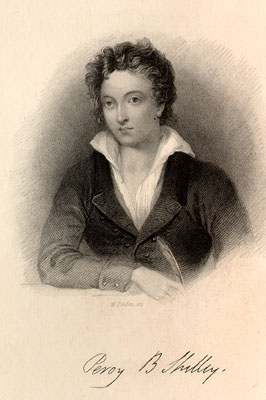
Percy Bysshe Shelley


I met a traveller from an antique land
Who said: "Two vast and trunkless legs of stone
Stand in the desert. Near them on the sand,
Half sunk, a shattered visage lies, whose frown
And wrinkled lip and sneer of cold command
Tell that its sculptor well those passions read
Which yet survive, stamped on these lifeless things,
The hand that mocked them and the heart that fed.
And on the pedestal these words appear:
'My name is Ozymandias, King of Kings:
Look on my works, ye mighty, and despair!'
Nothing beside remains. Round the decay
Of that colossal wreck, boundless and bare,
The lone and level sands stretch far away". 

I know, I know . . . that's a lot more than two or three lines.  But which lines would you have me cut?  There's no fat in this poem -- it's all muscle.

Shelley wrote this poem in 1817, when he was 25 years old.  He drowned while sailing off the west coast of Italy in 1822, a month before his 30th birthday.

"Ozymandias" (pronounced with four syllables to fit the meter of the poem) is a Greek name for Ramesses II (who is also known as "Ramesses the Great"), the most celebrated of all Egyptian pharaohs. 

Shelley's poem reminds us of a truth that is bitter to many, but impossible to refute.  No matter how monumental the accomplishments of a man may be, there will come a time when his works will decay into a "colossal wreck," leaving those who come later to observe (as did Shelley): "Nothing beside remains."

Or, to put it another way, Vanitas vanitatum, omnia vanitas.

Percy Bysshe Shelley

Wednesday, December 21, 2011

Ecclesiastes


Vanitas vanitatum, omnia vanitas
The Vulgate (Latin) Bible's rendering of Ecclesiastes 1:2 has been translated into English in many different ways.  

From the King James Bible: Vanity of vanities, saith the Preacher, Vanity of vanities; all is vanity.

From the New International Version:  "Meaningless! Meaningless!" says the Teacher.  "Utterly meaningless!  Everything is meaningless."

St. Jerome, who translated the Bible from Hebrew into Latin in the fourth century, translated the Hebrew word hebel as vanitas, and the English equivalent for vanitas is vanity.  

The usual meaning of vanity today is having an inflated pride in one's importance or personal appearance.  (Think Carly Simon's song, "You're So Vain.")  But the roots of the word hebel indicate vapor, fog, steam, or breath -- all of which are transitory, ephemeral, and without lasting substance.

We think that making money, building buildings, writing books, and all the other things that humans do matter.  But do they really?

As the author of Ecclesiastes goes on to say:

No one remembers the former generations, and even those yet to come
will not be remembered by those who follow them.
Over the next three days, 2 or 3 lines a day will continue to explore this theme.

"Vanitas," by Pieter Claesz (1630)

Tuesday, December 20, 2011

Hank Snow


Boston, Charleston, Dayton, Louisiana 
Washington, Houston, Kingston, Texarkana
Monterey, Ferriday, Santa Fe, Tallapoosa 
Glen Rock, Black Rock, Little Rock, Oskaloosa
Tennessee, Hennessey, Chicopee, Spirit Lake
Grand Lake, Devil's Lake, Crater Lake, for Pete's sake
I've been everywhere, man
I've been everywhere
From his 1962 hit single, "I've Been Everywhere," which originally listed Australian place-names.  

Hank Snow, who was born in Nova Scotia in 1914, died on this date in 1999.  "I've Been Everywhere" was one of his seven #1 hits.  I've watched this video several times and I still don't believe it.


Monday, December 19, 2011

The Onion


STUDY FINDS LINK BETWEEN RED WINE, LETTING YOUR MOTHER KNOW WHAT YOU REALLY THINK

This was the headline of the December 14 page of my 2011 The Onion Page-A-Day Calendar.  

The story went on to say that a previously unknown ingredient in red wine "has been shown to cause a marked improvement in vocal clarity and emotional acuity -- while reducing overall inhibition -- after only four glasses."  2 or 3 lines a day is bringing you this news just in time for you to put it to good use at all those holiday gatherings with your family.  

The Onion newspaper was founded at the University of Wisconsin (Madison) in 1988.  Today The Onion is on TV and radio as well, and has a wildly popular website -- about 7.5 million unique visitors per month.  2 or 3 lines a day would kill for numbers like those.

From The Onion


Sunday, December 18, 2011

Walter Isaacson


At one point, the pulmonologist tried to put a mask over [Steve Jobs's] face when he was deeply sedated.  Jobs ripped it off and mumbled that he hated the design and refused to wear it.  Though barely able to speak, he ordered them to bring five different options for the mask and he would pick a design he liked. . . . He also hated the oxygen monitor they put on his finger.  He told them it was ugly and too complex.
Walter Isaacson's biography portrays Steve Jobs as a complicated and exhausting man.  In an article about Isaacson's book, Malcolm Gladwell concludes that Jobs was "a bully."  

During his final hospital stay, when Jobs wasn't criticizing the design of his oxygen mask, he was complaining about nurses.  According to Isaacson, Jobs went through 67 nurses before finding three that were acceptable to him.

According to Gladwell, Jobs was a "tweaker."  The first MP3 player came out five years before the iPod, and there were other smartphones and tablet computers long before there was the iPhone and the iPad.  But Jobs had a gift for "ruthlessly refining" the inventions of others, Gladwell says.

Steve Jobs a few months before his death


Saturday, December 17, 2011

John Greenleaf Whittier


God pity them both! and pity us all,
Who vainly the dreams of youth recall;
For of all sad words of tongue or pen,
The saddest are these: "It might have been!"

From his 1856 poem, "Maud Muller."  

Maud Muller was a poor country girl who was raking hay on a hot summer day when a local judge saw her as he rode by on horseback.  He stopped to ask for a cup of spring-water, and they chatted for a few minutes.  The judge was smitten by the beautiful young woman, but as he rode away, "he thought of his sisters, proud and cold/And his mother, vain of her rank of gold."  So he closed his heart and "wedded a wife of richest dower/Who lived for fashion, as he for power," while Maud married a local bumpkin, bore and reared many children, and worked like a dog.  

As the years passed, both Maud and the judge thought of what might have been . . . but wasn't.

Whittier was born on this date in 1807.


Friday, December 16, 2011

Kanye West


Prince William ain’t do it right 
If you ask me
'Cause if I was him 
I would have married Kate and Ashley

From Kanye and Jay-Z's 2011 single, "Niggas in Paris," which is #2 on Rap Genius's list of the best 100 rap songs of 2011.  Click here to see all 100.

No, I haven't forgotten that we're supposed to be featuring Jay-Z on "Rap Fridays" this month.  But Jay-Z and Kanye are BFFs -- they released a collaborative studio album titled Watch the Throne earlier this year that included this song, and are coming to the end of a wildly successful joint tour.  (I walked out of my office one night in November and found myself in the middle of an enormous crush of people.  Turns it that was the night Kanye and Jay-Z were performing at the Verizon Center, which is directly across the street from my Washington, DC office.)    

Jay-Z's "Niggas in Paris" verse is pretty good, but how could I -- a father of twins who were huge Full House fans and born in 1986 (just like Mary-Kate and Ashley Olsen) -- resist these lines, which are 100% Kanye?

And 'Ye is 100% right.  Nothing wrong with Kate Middleton, but we're talkin' Mary-Kate and Ashley!


Thursday, December 15, 2011

Ellen Willis


There are two kinds of sex, classical and baroque.  


Classical sex is romantic, profound, serious, emotional, moral, mysterious, spontaneous, abandoned, focused on a particular person, and stereotypically feminine.

  
Baroque sex is pop, playful, funny, experimental, conscious, deliberate, amoral, anonymous, focused on sensation for sensation's sake, and stereotypically masculine.

  
The classical mentality taken to an extreme is sentimental and finally puritanical; the baroque mentality taken to an extreme is pornographic and finally obscene. Ideally, a sexual relation ought to create a satisfying tension between the two modes (a baroque idea, particularly if the tension is ironic) or else blend them so well that the distinction disappears (a classical aspiration).


From a magazine article later published in her 1981 book, Beginning to See the Light: Pieces of a Decade.

Ellen Willis, who was born on December 14, 1941, was a left-wing political essayist, a "sex-positive feminist," and the New Yorker's first pop music critic.  She died of lung cancer in 2006.


Ellen Willis in 1981

Wednesday, December 14, 2011

Sir James George Frazer


On the Day of Atonement, which was the tenth day of the seventh month, the Jewish high-priest laid both his hands on the head of a live goat, confessed over it all the iniquities of the Children of Israel, and, having thereby transferred the sins of the people to the beast, sent it away into the wilderness.  The scapegoat upon whom the sins of the people are periodically laid, may also be a human being.

From his groundbreaking study of comparative mythology and religion, The Golden Bough, first published in 1890.

The Boston Red Sox, who were leading the New York Mets three games to two in the 1986 World Series, scored two runs in the top of the 10th inning of game six and were only one out away from finally breaking the "Curse of the Bambino" after retiring the Mets' first two batters in the bottom of the 10th. 

But the Mets hit three consecutive singles off Calvin Schiraldi, and when reliever Bob Stanley uncorked a wild pitch, the game was tied.  The next batter, Mookie Wilson, hit a slow roller to Red Sox 1B Bill Buckner for what should have been the third out, but somehow the ball got through Buckner's legs, giving the Mets the victory.

In game seven, the Red Sox held a 3-0 lead, but the Mets scored three runs of starter Bruce Hurst in the sixth inning and three more off reliever Schiraldi in the seventh, and held on to win.

Buckner was scapegoated for the defeat by Red Sox fans.  He was the target of death threats, and was heckled and booed by his own fans until the Red Sox released him in July 1987.  His wife was harassed so much that Buckner moved his family from Boston to Boise, Idaho.  

The roles of Schiraldi, Stanley, and Red Sox manager John McNamara (who failed to insert a defensive replacement for the 36-year-old, sore-ankled Buckner, despite having done so in the three previous Red Sox victories in that World Series) in the Red Sox defeat were overlooked by the vast majority of Boston partisans.  Who knows why?

Bill Buckner is 62 years old today.  Ironically, my wife -- who is a Red Sox fan -- was also born on December 14.  (I share a birthday with Manny Ramirez.  Go figure.) 


Tuesday, December 13, 2011

Julian Barnes


Dumas would ride his horse into a stable, seize an overhead beam, grasp the horse tightly with his legs, and lift it off the ground.  He also claimed to have 365 illegitimate children scattered round the world: one for every day of the year.  The energy made you wince.  

From his first novel, Metroland, which was published in 1980.

The "Dumas" referred to here is the famous French novelist, Alexandre Dumas, père, author of The Three Musketeers and The Count of Monte Cristo.   Alexandre Dumas, fils -- who was a very successful dramatist -- was one of his illegitimate children.  

But most historians attribute the lift-the-horse feat not to Dumas, père, but to his father, Thomas-Alexandre Dumas -- a general in Napoleon's army who was himself the illegitimate son of a French officer and a Haitian woman.

I don't know what to say about all this, except that it makes a good "French-day the 13th" subject.


General Thomas-Alexandre Dumas